
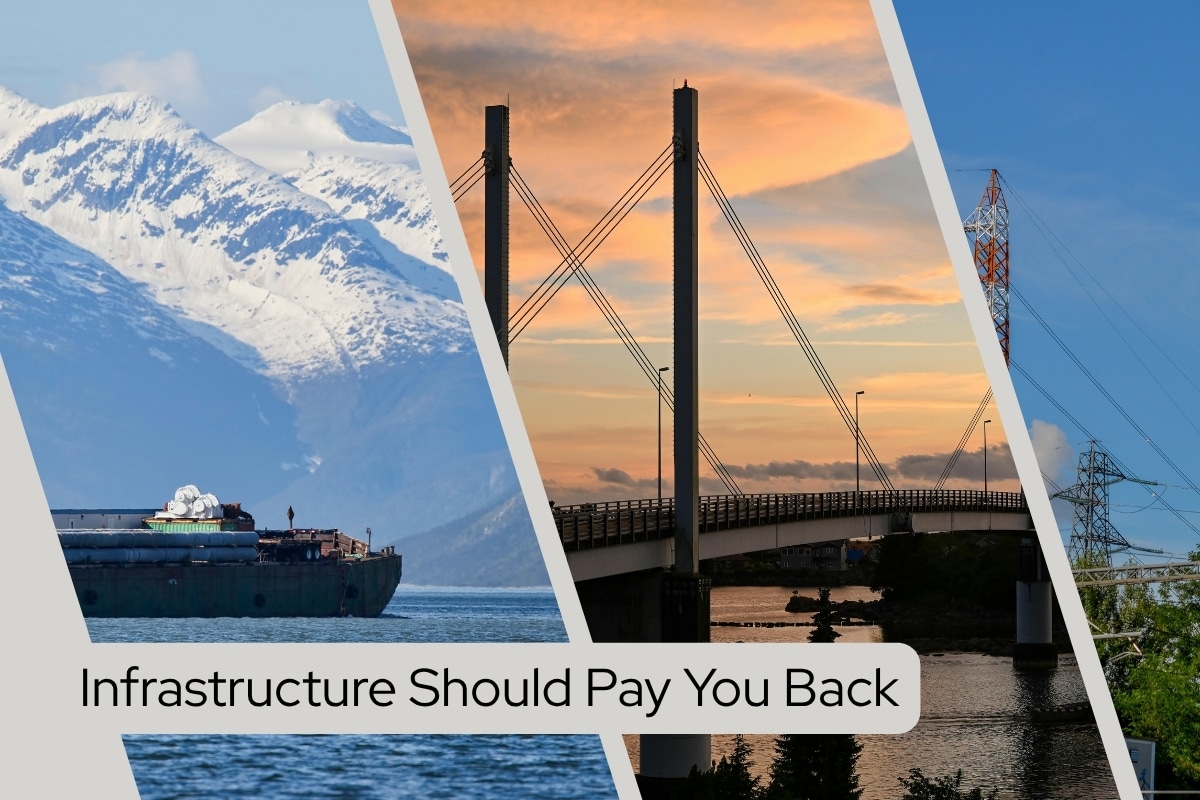
“Infrastructure” can feel abstract. But it shows up directly in your everyday costs—your grocery bill, your heating bill, your rent, and the price of doing business. The FTFAF Economic Growth Strategy makes this clear: when infrastructure is unreliable or constrained, costs rise. When it is predictable and efficient, life becomes more affordable.
What Good Infrastructure Does
The FTFAF plan defines effective infrastructure as investments that lower transaction costs and expand opportunity. When transportation, energy, and logistics systems work smoothly, businesses invest, families stay, and private capital flows into the community. Predictability is not a luxury—it is the foundation of affordability.
Real Projects Already Underway
Juneau is beginning to see movement on several priority infrastructure fronts identified in the FTFAF Economic Growth Strategy—projects that directly reduce costs, increase reliability, and support long‑term private‑sector growth.
- Permanent GLOF Protection — Basin Engineering + Tunnel Tap Concept
Federal action is accelerating Juneau’s path toward a permanent fix for Suicide Basin flooding. The Water Resources Development Act of 2026, advanced by the U.S. Senate Environment and Public Works Committee, directs the U.S. Army Corps of Engineers to skip early study phases and move directly into pre‑construction engineering and design for a long‑term solution. Alaska’s congressional delegation described this as cutting “right through the red tape,” reflecting national recognition that annual GLOF events are predictable and preventable.
Alongside federal engineering work, local discussion has expanded to include a “tunnel tap” drainage concept, modeled on standard mining methods. Community members and engineers have proposed drilling a controlled tunnel into Suicide Basin to allow predictable, engineered drainage—reducing catastrophic releases and stabilizing insurance and property values. This complements the protective berm construction already underway near Back Loop Road, forming a combined strategy: basin‑level engineering + neighborhood‑level protection.
- Integrated Energy, Marine Freight & Overland Transportation System
Recent state and federal actions support FTFAF’s call for a unified logistics system:
- The Water Resources Development Act of 2026 includes Alaska coastal infrastructure provisions and improved permitting capacity—critical for Juneau’s port modernization.
- The Alaska Energy Authority’s Juneau Port Electrification project invests $9.15 million to extend transmission infrastructure and provide shore power for large vessels, lowering fuel costs and improving port efficiency.
- DOT&PF’s Cascade Point Ferry Terminal will shorten Lynn Canal ferry routes by 48 nautical miles per round trip, reducing run‑time by roughly three hours and dramatically improving schedule reliability.
Together, these investments support an integrated system: overland road access → short‑run ferries → electrified ports → lower freight cost per ton.
- Aak’w Landing Waterfront Development
Aak’w Landing continues advancing through regulatory and design phases and is positioned to become Juneau’s most significant mixed‑use waterfront development. With a deepwater dock, commercial space, and year‑round tourism infrastructure, the project aligns directly with FTFAF’s strategy to broaden Juneau’s private‑sector base and attract long‑term investment.
Looking Ahead
Next, we’ll explore how private‑sector growth—not government expansion—drives long‑term affordability, and how Juneau can align public action with market incentives to reverse population decline and strengthen the local economy.
— First Things First Alaska Foundation